AACN Transform Poster Showcase
Turnover in the Critical Care Work Environment: Targeting Competencies for Self-Care
Honorable Mention
Topic: Leading & Advancing Improvements in Health, Health Care, & Higher Education
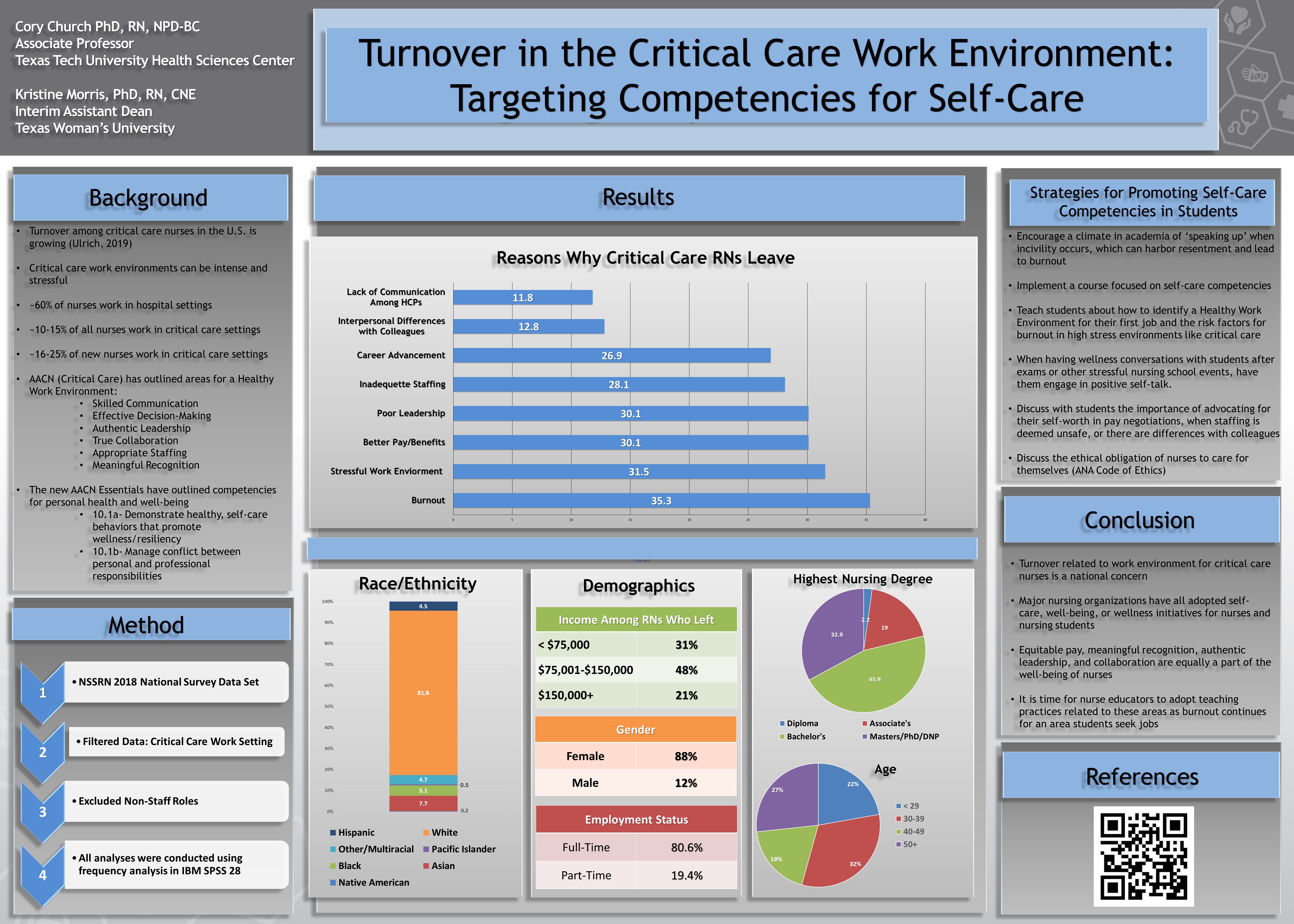
Background/Introduction: Turnover among critical care nurses in the U.S. is escalating. Thirty-three percent of critical care nurses intend to leave their current positions within 12 months. Many new nurses transition into hospital critical care work environments and new nurse turnover is alarming. It is important that nurse educators target self-care competencies for students.
Purpose: The purpose of the study was to determine the reasons for turnover in the critical care work environment to determine the need for a focus on self-care competencies in nursing education.
Methods or Processes/Procedures: This study was a secondary analysis of the 2018 National Sample Survey of Registered Nurses (NSSRN). Frequency analyses and a chi-square test for associations were conducted. 3,580 respondents were identified as being employed in critical care.
Results: The turnover rate among critical care nurses was 13.9%. The top six reasons for leaving cited by critical care nurses were burnout, stressful work environment, lack of good management/leadership, better pay/benefits, inadequate staff, and career advancement/promotion opportunities. Nurses in critical care work environments were more likely than non-critical care nurses to report leaving jobs due to burnout, career advancement, career change, enrolling in an educational program, inadequate staffing, pay, and physical demands of the job.
Limitations: A limitation of the study is those survey items on the NSSRN related to turnover were multiple response items, meaning that respondents could select one or more reasons and selected reasons were not ranked.
Conclusions/Implications for Practice: Turnover of critical care nurses remains a national concern. This analysis revealed that factors related to the overall health of the work environment played a powerful role in the decision of critical care nurses to leave a position. The new Essentials outline self-care competencies. These competencies should be targeted in preparing new graduates for transition into critical care work environments.

Cory Church
PhD, RN, NPD-BC
Biography
Dr. Church is an Associate Professor of Nursing at the Texas Tech University Health Sciences Center, School of Nursing in the Traditional Undergraduate Program. Dr. Church's scholarship globally focuses on nursing workforce issues specifically nurse residency programs. Dr. Church is certified in nursing professional development by the ANCC.
Kristine Morris currently serves as the Interim Assistant Dean at Texas Woman’s University’s Dallas campus. Her scholarship revolves around the identification of barriers and bridges to nursing student success. Her goal is to help craft a knowledgeable, skilled, and resilient professional nursing workforce that is representative of the nation's population.
Email: corchurc@ttuhsc.edu
Co-Author(s)
Kristine Morris, PhD, RN, CNE