AACN Doctoral Education Poster Showcase
Using Predictive Analytics and Machine Learning Algorithms to Design Immersive Learning Modules for Health Professions Students
Topic: Academic Nursing: Excellence & Innovation
Category: Research Project
Background/Introduction:
Pattern recognition is a critical skill health professionals need to conduct effective diagnostic reasoning. Nevertheless, resources and instruction time to teach strategies for pattern recognition to health professions students are limited. Furthermore, students with different learning styles may benefit unequally from a well-designed course with variety of clinical experiences.
Purpose:
The primary goals of this study are to identify the characteristics of health profession students who would benefit from learning pattern recognition via immersive technologies and to identify barriers that may interfere with student learning. The overarching goal of this study is to develop interactive virtual trainings with task-based assessments technology for the understanding of health profession students’ approach to symptom recognition using immersive technologies.
Methods or Processes/Procedures:
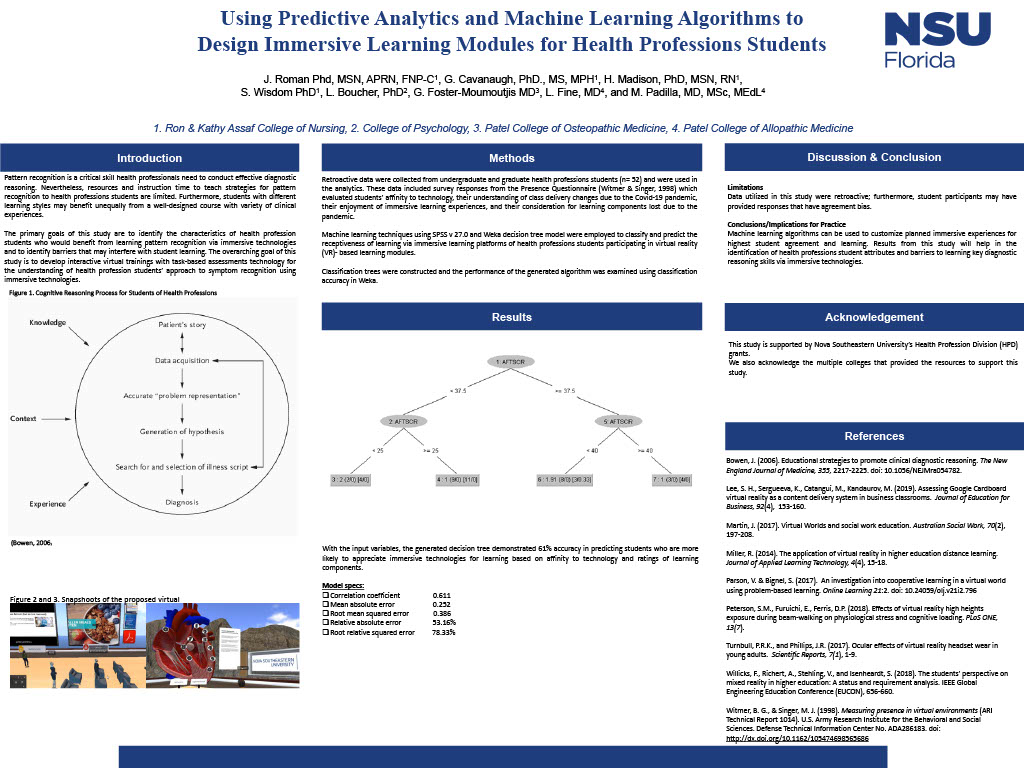
Prior to recruitment, machine learning techniques using SPSS v 27.0 and WEKA decision tree model were employed to classify and predict the receptiveness of learning via immersive learning platforms of health professions students participating in virtual reality (VR)- based learning modules. Retroactive data used in these analytics were collected from undergraduate and graduate health professions students. Surveys were prepared to evaluate the students’ affinity to technology, their understanding of class delivery changes due to the Covid-19 pandemic, their enjoyment of immersive learning experiences, and their consideration for learning components that are lost due to the pandemic. In WEKA, classification trees were constructed, and the performance of the generated algorithm was examined using classification accuracy.
Results:
The generated decision tree had 61% accuracy in predicting students who are more likely to appreciate immersive technologies for learning based on affinity to technology and ratings of learning components.
Limitations:
Data utilized in this study was retroactive. In addition, student participants may have provided data that has agreement bias.
Conclusions/Implications for Practice:
Machine learning algorithms can be used to customize planned immersive experiences for the highest student agreement and learning. Results from this study will identify health professions student attributes and barriers to learning key diagnostic reasoning skills via immersive technologies.

Jessica Roman
PhD, MSN, APRN, FNP-C
Biography
All authors are faculty in NOVA Southeastern University. Jessica Roman, PhD, MSN, APRN, FNP-C. Gesulla Cavanaugh, Ph.D., MS, MPH, Holly Madison, PhD, MSN, RN, and Sonia Wisdom, are faculty in the Assaf College of Nursing. Leanne Boucher, PhD is an associate professor in the College of Psychology. Gina Foster-Moumoutjis MD is an assistant professor in the Patel College of Osteopathic Medicine. Lauren Fine, MD is an assistant professor in the Patel College of Allopathic Medicine. Maria Padilla, M.D., M.Sc., M.Ed.L. is an associate professor and Executive Associate Dean for Academic and Student Affairs in the Patel College of Allopathic Medicine.
Email: jv332@NOVA.EDU
Co-Author(s)
Gesulla Cavanaugh
Holly Madison, PhD
Lauren Fine
Leanne Boucher
Sonia Wisdom
Gina Foster-Moumoutjis
Maria Padilla