AACN Fall Faculty Forum Poster Showcase
Equipping Future Nurses to Consume and Produce Health Information for Greatest Impact in a Digital World
Quality Improvement/Evidence-based Practice Project
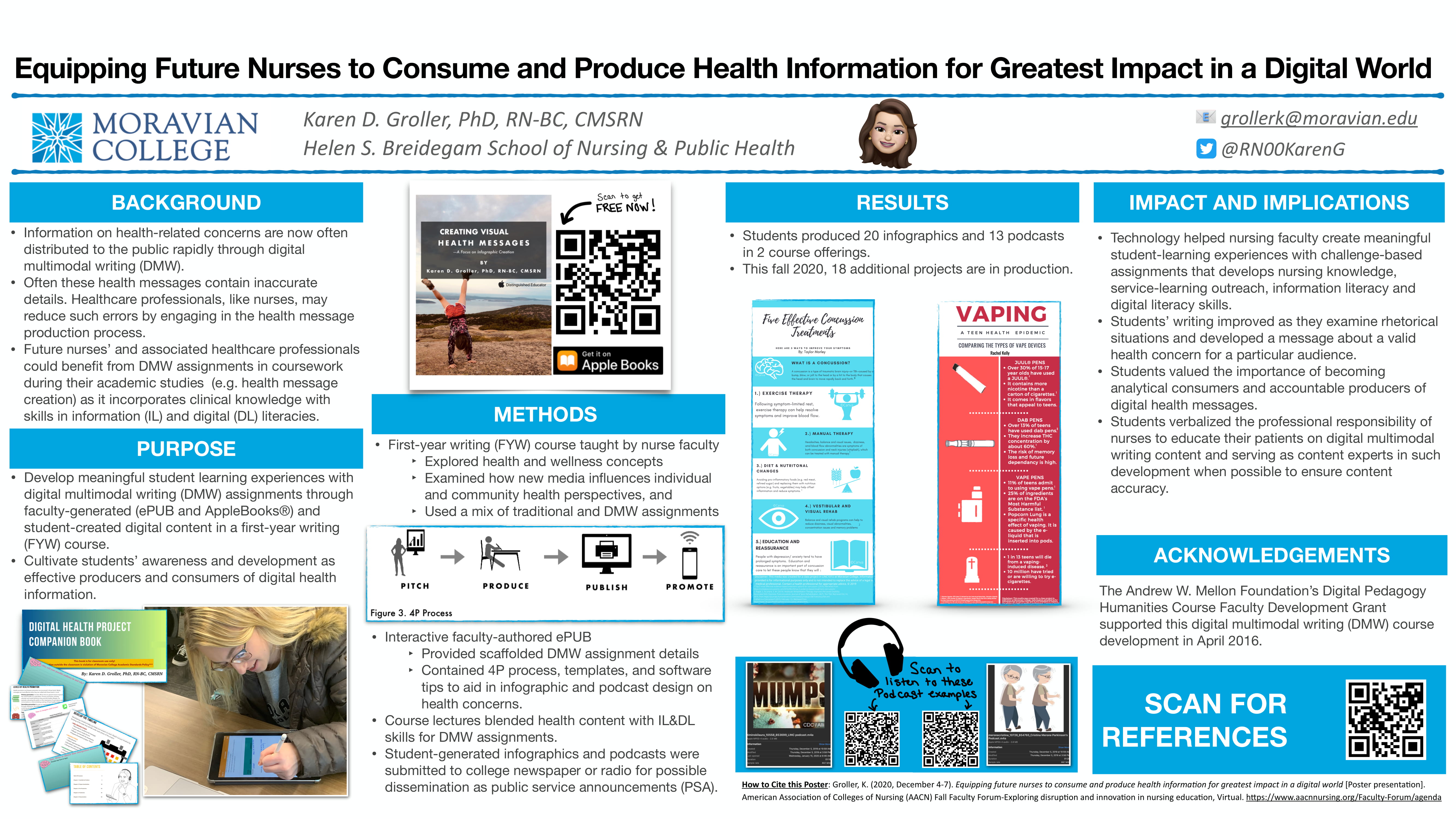
Introduction: Digital multimodal writing (DMW) uses mixtures of audio, visual, spatial, gestural, contextual elements (e.g.- graphic, podcast, webpage) to communicate messages with others on new/social media (e.g.-Twitter®, Instagram®). Society circulates DMW rapidly in common and new media streams; often containing inaccurate information. Nurses can reduce errors by serving as content experts during health message production before public dissemination through new media venues. A nursing professor took a first-year writing (FYW) course and a mix of traditional and DMW assignments to develop future nurses’ skills in information and digital literacies (IL&DL), explore health and wellness concepts, examine how new media influences individual and community health perspectives, and create digital health messages.
Purpose: This presentation describes how faculty-generated (ePUB and AppleBooks®) and student-created digital content (infographics and podcasts) made meaningful learning experiences that enhanced faculty and student IL&DL skills through innovative teaching methods associated with DMW assignments.
Methods: Students became analytical consumers and accountable producers of digital health messages through scaffolded DMW assignments stemming from traditional research papers. The interactive faculty-authored ePUB explained DMW assignments and aided infographic and podcast design by containing the 4P process, templates, and software tips (e.g.- Keynote®, Canva®, GarageBand®, Anchor®) to educate others on health concerns. Course lectures blended health content with IL&DL skills for DMW assignments. Infographics and podcasts were submitted to college newspaper or radio for possible dissemination as a public service announcement.
Results: Students produced 20 infographics and 13 podcasts and improved as writers by developing straightforward, valid health messages.
Limitations: Despite dedicated efforts, project limitations occurred occasionally in either locating royalty-free design elements or attaining information to cite them appropriately.
Conclusions: Students valued nurses educating patients on DMW content and serving as content experts. Technology helped nursing faculty create meaningful student-learning experiences with challenge-based assignments that developed nursing knowledge, IL&DL skills, and service-learning outreach.

Karen Groller
PhD, RN-BC, CMSRN
Assistant
Moravian College
Biography:
Dr. Groller is an Assistant Professor at Moravian College, an Apple® Distinguished School in Bethlehem, Pennsylvania. She attained her B.S. in Nursing from Cedar Crest College, M.S. in Nursing from DeSales University, and Doctorate of Philosophy (PhD) in Nursing from the University of Kansas.
She maintains active certifications in Cardiac/Vascular and Medical-Surgical nursing. Dr. Groller became an Apple® Distinguished Educator in 2019; being the first to receive this distinction at Moravian. She is a well-published nurse researcher, educator, and expert in the fields of obesity management, particularly bariatric surgery education practices, and digital education pedagogies.
Phone: (610) 533-4252
Email: grollerk@moravian.edu