AACN Doctoral Education Poster Showcase
Academic Nursing: Leading in Excellence & Innovation
Background/Introduction:
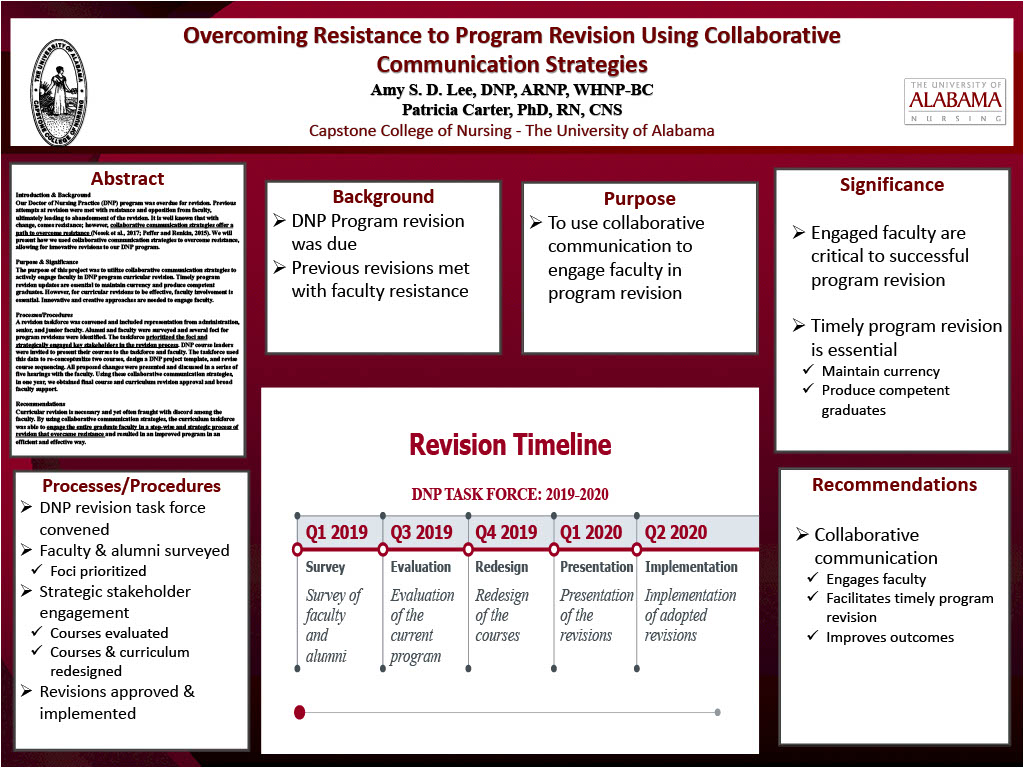
Our Doctor of Nursing Practice (DNP) program was overdue for revision. Previous attempts at revision were met with resistance and opposition from faculty, ultimately leading to abandonment of the revision. It is well known that with change, comes resistance; however, collaborative communication strategies offer a path to overcome resistance. We will present how we used collaborative communication strategies to overcome resistance, allowing for innovative revisions to our DNP program.
Purpose:
The purpose of this project was to utilize collaborative communication strategies to actively engage faculty in DNP program curricular revision.
Methods OR Process/Procedures:
A DNP revision taskforce was convened and included representation from administration, senior, and junior faculty. Alumni and faculty were surveyed and several foci for program revisions were identified. The taskforce prioritized the foci and strategically engaged key stakeholders in the revision process. DNP course leaders were invited to present their courses to the taskforce and faculty. The taskforce used this data to re-conceptualized two courses, design a DNP project template, and revise course sequencing. All proposed changes were presented and discussed in a series of five hearings with the faculty.
Results:
Using these collaborative communication strategies, in one year, we obtained final course and curriculum revision approval and broad faculty support.
Limitations:
Curricular revision is necessary and yet often fraught with discord among the faculty. Innovative and creative approaches are needed to engage faculty.
Conclusions:
Timely program revision updates are essential to maintain currency and produce competent graduates. However, for curricular revisions to be effective, faculty involvement is essential. By using collaborative communication strategies, the curriculum taskforce was able to engage the entire graduate faculty in a step-wise and strategic process of revision that overcame resistance and resulted in an improved program in an efficient and effective way.

Amy Lee
DNP, ARNP, WHNP-BC
Biography
Dr. Amy Lee is a Clinical Associate Professor and the DNP Program Coordinator at the Capstone College of Nursing, the University of Alabama. Dr. Lee is a Women’s Health Nurse Practitioner and holds the Doctor of Nursing Practice degree. From 2002 until 2018, Dr. Lee served at the Johns Hopkins Hospital with joint appointment at the Johns Hopkins School of Nursing. Dr. Patricia Carter is a Professor and Assistant Dean for Graduate Programs at the Capstone College of Nursing, the University of Alabama. Prior to this position, Dr. Carter was at the University of Texas at Austin School of Nursing.
Email: adlee5@ua.edu
Co-Author(s):
Patricia Carter, PhD, RN, CNS